

At a glance
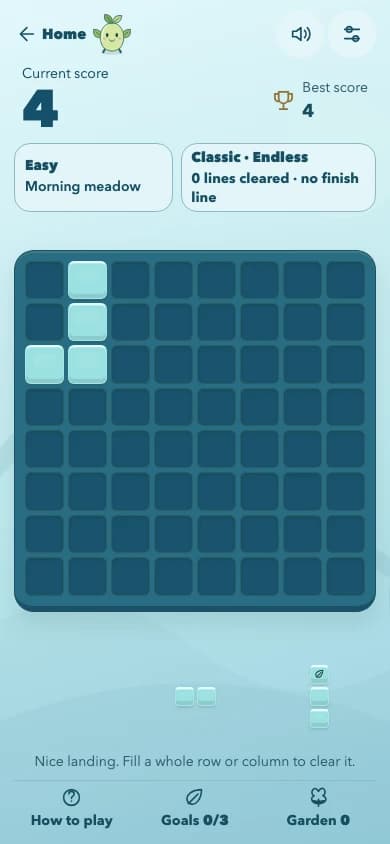
Choose a piece from the tray, fit it entirely into empty cells, and fill a row or column to clear it. Adventure gives you a level goal; Classic asks how long you can keep making space. There is no countdown on the puzzle board.
Your first useful habit in BlockBloom is to look at the whole tray before touching the board. The small piece that fits almost anywhere may be the exact piece you need to make room for a larger one. You choose both the piece and its destination; the game does not make that placement for you.
This guide covers the current website beta. You can open it on a phone or computer without an account or download. The website build is free and currently has no ads or purchases. Start with Adventure if you want a clear short-term objective, or Classic if you prefer an open-ended score chase.
Make one deliberate placement
Pick a shape from the tray and drag it over the board. Its entire footprint must sit inside the board and avoid occupied cells. An empty square inside a shape’s surrounding rectangle is not an extra block: check the actual cubes, rather than imagining a solid rectangle around them.
You can also select a piece and then choose a place on the board. This is useful if a finger obscures the landing position or you simply prefer tapping. If you touch the board before choosing a piece, select one from the tray first. The game leaves that choice to you.
- Look for the largest or most awkward shape in the current tray.
- Check where every cube would land, including any projecting arm.
- Place the piece only when the preview is where you intended.
- Look at the updated board before deciding where the next piece goes.
A complete line creates new room
Filling a row or column clears its blocks. A placement can complete more than one line, which is why a single shared gap can be valuable. The board changes after the clear: a space that was blocked a moment ago may now accept the piece you were saving.
For an illustrative example, imagine a row with two adjacent empty cells and a matching two-cube piece in your tray. Filling those cells clears the row. Before taking the move, check whether the other pieces fit afterward. This is an example of how to think, not a prescribed opening or a guarantee about the pieces you will receive.
You do not have to make the biggest possible clear every turn. A modest clear that preserves a broad empty area can be more useful than a spectacular placement that leaves several isolated holes.
Choose the goal you actually want to play
Adventure and Classic share the placement rules but ask you to pay attention to different things. Read the goal area when a level begins, especially if you are returning to a saved game.
Compare all columns. Scroll sideways if needed.
| Mode | What matters | Where to look |
|---|---|---|
| Adventure | Finish the displayed line or collection target | The level goal and remaining icons |
| Classic | Keep the board playable and build your score | Current score, personal best, and the tray |
Keep usable space, not just empty space
Ten empty cells scattered around a board are not equivalent to ten connected cells. Long pieces need a suitable run of cells; square pieces need width as well as height. Tiny holes may look tidy while leaving very few options.
Try to keep one reasonably open area while you work on a line elsewhere. This is a flexible habit, not a rule to put every block against an edge. An edge placement is only helpful if the remaining shapes still have somewhere to go. When you get stuck, review the last placement that split your empty area; that usually teaches more than focusing only on the final piece.
Take a different kind of puzzle break
The garden gives you a place to spend time between boards. More Games also includes Petal Pairs, Water the Roots, and Bloom Shapes. Petal Pairs asks you to remember botanical pairs; Water the Roots uses rotating connections; Bloom Shapes fits a fixed set of pieces into a silhouette. These activities are untimed and free in the website beta.
Their progress and garden arrangements are stored on the device. They are not included in the current main-game cloud-save slots. If you want to move to another browser, read the save guide before assuming your entire garden will travel with the Adventure board.
Your next move
For your first session, aim for one clear, then explain to yourself why the next two pieces still fit. That small pause builds a more useful habit than rushing toward a score.
Play BlockBloomSources & further reading
Checked against the website betas on 30 October 2026. Game rules and prices may change during development.
- BlockBloom: current game and controls
First-party overview of the browser beta, modes, placement controls, and save boundaries.
- Play BlockBloom
The playable website build this guide describes.

From Rewritely Games
We make BlockBloom and Humble Hustle. These first-party guides explain the games we build, including their current limits.