

At a glance
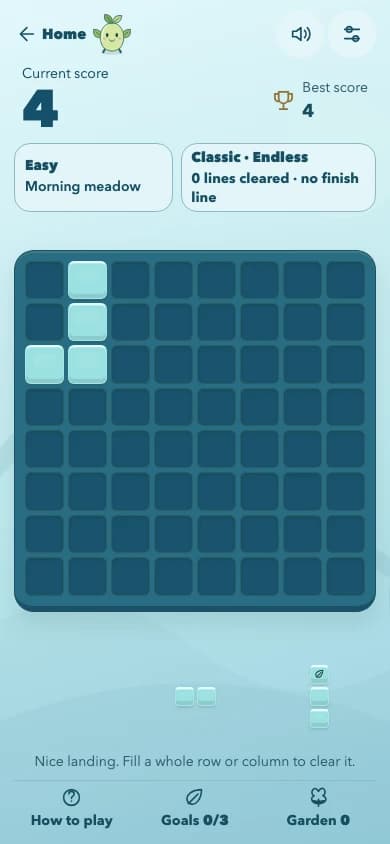
BlockBloom uses board state and recent play to rank candidate trays. It checks a legal route through the three new pieces, including clears between moves. It does not guarantee every placement will work, and ad availability or value does not enter the difficulty decision.
When a puzzle adapts, players deserve to understand what is adapting. There is a meaningful difference between offering a gentler set of shapes, preserving a route through a tray, and deciding that someone must win or lose. Those are not interchangeable claims.
Our current BlockBloom dealer is a bounded, rule-based system. It uses the current run’s placements, clears, board pressure, and collection targets. It is not a trained profile of a player’s personality, and we do not claim to know a competitor’s private algorithm. This article explains our own implementation.
The smallest useful promise is about the current tray
Before offering a new three-piece tray, the dealer searches for a legal sequence through it. The search accounts for lines disappearing between placements. This prevents the simple failure of judging every piece only against the starting board when an earlier clear might make room.
The promise has a precise boundary: at least one verified sequence exists at deal time. The player can choose another placement that closes that route. Future trays are also outside that proof. A playable current tray is therefore not a guaranteed level completion or an endless winning run.
We prefer this narrower statement because it describes something we can check. ‘Every game is fair’ would be much broader and would need evidence about experience, balance, and accessibility that a move search alone cannot provide.
Support responds to the board and the current run
The early placements receive learning protection. Later decisions consider a smoothed clearing rate rather than treating a single strong or weak move as a reliable skill estimate. Crowded or fragmented boards and trays without clears can shift the dealer toward recovery.
The ranking also looks at the kind of space left by a candidate sequence. A wide opening, a long lane, and several isolated holes have different practical value. Checking future usable space helps distinguish two trays that are both technically playable but leave very different positions.
This is bounded look-ahead. It samples possibilities within a limited search budget; it does not examine every possible future game. Its purpose is to improve the next decision, not to turn a browser puzzle into an exhaustive solver.
Adventure adds the value of the remaining targets
A legal sequence in Adventure should also be useful to the level goal. The candidate ranking replays collection markers along the route and values progress toward quotas that are still outstanding. Near the end of a collection level, useful remaining targets receive more emphasis.
It does not count already-completed quotas as if they were fresh progress, and it does not grant a target without a clear. The board rules remain the same. This helps explain why a collection goal can influence a tray while the player still needs to solve the placement problem.
Ad decisions stay outside the dealer
The difficulty code does not use ad availability, ad value, purchases, account identity, or analytics consent to select a hand. Optional ad pacing is a separate system with its own eligibility and frequency rules. The website beta discussed here has ads switched off.
Separating those inputs gives us an important engineering boundary: making an ad available should not make the next puzzle harder. It also avoids describing an unavailable website reward as if it were a working feature. If the distribution changes, the player-facing explanation needs to change with it.
What our tests can—and cannot—tell us
We can replay seeded runs, validate placements, reload saves, and check whether a claimed route really fits. We can compare synthetic players that choose randomly, favor clears, or preserve usable space. Those checks are useful for finding impossible states and regressions.
A simulated policy is not a person. Passing those checks does not establish that players feel challenged at the right moments, return a week later, or enjoy the messages. We do not present synthetic win rates as human retention evidence.
The next useful evidence is specific player feedback: which piece felt impossible, what the board looked like, and what the player expected. That gives us a question we can reproduce. ‘Make it more addictive’ does not identify a rule that is wrong or an experience that should improve.
Your next move
An adaptive puzzle should have explainable boundaries. Our current boundary is a verified route through the new tray, responsive pacing, and no ad-value input—not a promise that every run ends in a win.
Play BlockBloomSources & further reading
Checked against the website betas on 30 October 2026. Game rules and prices may change during development.
- BlockBloom beta
First-party playable implementation. This article was checked against the shipped website source and its adaptive-play documentation.
- Privacy and playtest notes
Explains optional local playtest data and the website’s current advertising status.

From Rewritely Games
We make BlockBloom and Humble Hustle. These first-party guides explain the games we build, including their current limits.